A testimony that believes itself
Beau never steps outside his own language to explain the joke. He presents appetite as courage, attention as witness, and each consequence as evidence that the work mattered.
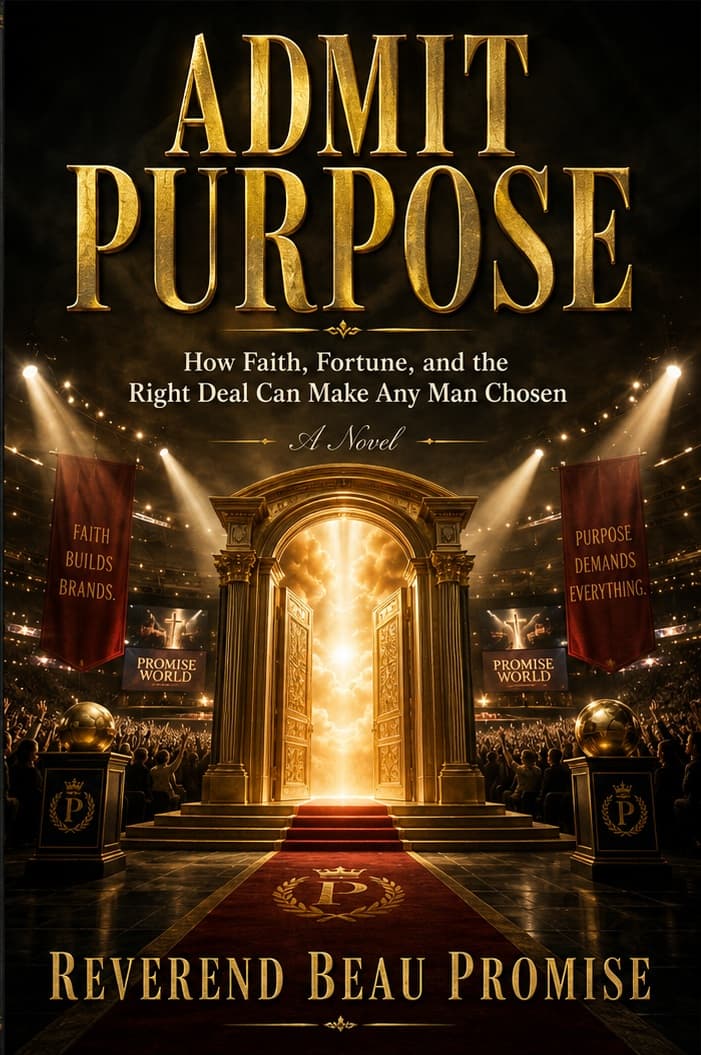
The cover Beau would have approved.
Promise World presents
A Novel
How Faith, Fortune, and the Right Deal Can Make Any Man Chosen
Written by Chris Aidan
Narrated and credited within the fiction to Reverend Beau Promise
Reverend Beau Promise built a church, a broadcast empire, a family institution, and a national movement from an abandoned tire shop. In the account he believes will restore his name, every confession becomes another lesson in how ambition acquires sacred language.
A man should admit what he wants. Then he should admit what he called it. Then he should admit what it cost.
The official trailer
The cinematic preview follows the novel from the first broken speaker to the final unpublished page. No sound autoplays, and every spoken line remains available as text.
Explore the full trailer page
Official book trailer
The novel
Promise World begins with thirty-six borrowed funeral-home chairs, six red seats from a bingo hall, a flowered restroom curtain, and sixteen people willing to listen while Reverend Beau Promise describes the institution he can already see.
As the church becomes a television ministry, a family enterprise, and a national political movement, Beau learns to call appetite vision, resistance persecution, obedience loyalty, and every cost proof that the work matters. His wife and children learn different uses for the same language. The people serving beneath the message learn what happens when an institution sees a cause before it sees a person.
Written in Beau's own polished, persuasive voice, Admit Purpose is a comic and increasingly cold account of charisma, family, public faith, private benefit, and a founder who becomes capable of telling the truth without losing his instinct to build an audience from it.
Inside Admit Purpose
Beau never steps outside his own language to explain the joke. He presents appetite as courage, attention as witness, and each consequence as evidence that the work mattered.
Darlene, Joshua, Micah, and Eden are not a choir of correct answers. Each loves Beau, uses the system, resists him differently, and wants something the institution can provide.
Invoices, board minutes, medical files, incident reports, donor scripts, and pledge cards reveal the moral hierarchy more clearly than Beau's sermons do.
The novel asks whether a founder can become more honest without surrendering the instinct to turn honesty into a platform, a mailing list, and one more door.
Read the complete opening
Chapter One begins with a private dinner, a returned steak, an abandoned tire shop, and the first proof that Beau's real gift is seeing people before he learns to use what he sees.
Read Chapter OneA weak man asks whether he deserves what he wants.
A strong man asks how soon it can arrive.
President Donald J. Trump never suffered from this confusion. He wanted the largest building, the strongest deal, the best table, and his name where people could see it.
Small men looked at this and saw pride.
I saw honesty.
He did not ask the world to guess his purpose. He placed it in gold letters above the door.
Editions
Premium print edition prepared for bookseller activation when final publication metadata is supplied.
Trade paperback edition prepared for retailer and independent-bookstore links.
Digital edition prepared for Kindle, Apple Books, Kobo, and other configured destinations.
Audio information will appear here only after the production and distribution plan is finalized.
Publication record
The jacket credits Reverend Beau Promise because Beau believes he wrote the account. The real-world publishing record identifies the actual novelist separately.
Open the press and rights centerBook clubs and classrooms
It is when he knows, what he does with that knowledge, and whether confession changes him or simply gives him better material.
Questions before entering
Clear publishing answers live here. Beau's explanations have been confined to the novel.
No. Reverend Beau Promise is the fictional narrator and in-world credited author of Admit Purpose. The novel is written by Chris Aidan.
No. Promise World, its institutions, documents, broadcasts, and characters belong to the fictional world of the novel. The website presents that world with institutional sincerity while clearly identifying the work as fiction.
The novel is fiction. It draws on recognizable American traditions of charismatic leadership, prosperity teaching, political branding, family institutions, and public religious language without presenting Promise World as a factual account of one real organization.
Because Beau believes he has written one. The book's commercial surface is part of the narrative: a testimony, a restoration campaign, and a confession that still understands good lighting.
The novel is interested in how admiration, grievance, branding, power, and flattering language operate inside Beau's mind and institutions. It does not reduce that inquiry to a campaign endorsement or a single partisan instruction.
Yes. The Reading Group Center includes spoiler-controlled discussion questions, character and relationship maps, the Promise World timeline, host and classroom guides, printable PDFs, and the central institutional worksheet: Who paid?
The book is the entrance
Begin with Beau's account, then enter the origin story, the people, the doctrine, and the archive that preserved what the message left outside the frame.